
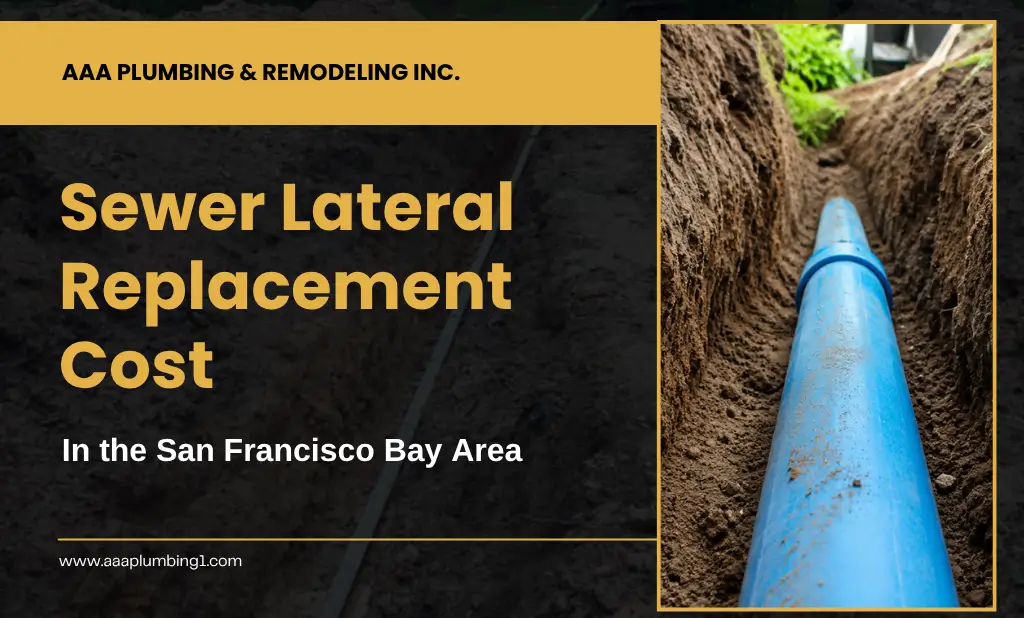
The Sewer Lateral Replacement Cost in the East Bay Area
A homeowner may face a large expense if a sewer lateral is damaged, particularly in the case where the pipe lies underneath a driveway, a sidewalk, some landscaping, or a public roadway. In the East Bay Area, the total cost of replacing a sewer lateral will vary according to the length and condition of the pipe, the excavation needed, access to the sewer main, the permits required, traffic control measures, the restoration work, and whether the project involves work in the public right-of-way.
For a large number of properties in the East Bay area, homeowners can anticipate having to pay several thousand dollars for the replacement of their sewer laterals, and in the case of more complicated jobs, the cost can reach well into the tens of thousands. At the moment, prices quoted by local contractors for an open-trench replacement on the property side range from about $7,000 to $15,000, $12,000 to $17,000 when the right-of-way section is also replaced, and roughly $25,000 to $80,000 for complicated projects involving factors such as hillsides, long laterals, or multifamily properties. It should be noted that these figures are merely examples from the market and not the official average for the Bay Area; hence, a site visit is required to obtain an accurate price.
The costs also differ greatly from one city to another. According to cost data published in 2026, the average cost of replacing a general sewer line is between $50 and $300 per linear foot, the amount depending on the type of pipe and the conditions of the project. This figure refers generally to sewer line replacement and must not be regarded as a fixed price for a private sewer lateral.
Table of Contents
What Is a Sewer Lateral?
A sewer lateral is a private pipe that carries wastewater from a house or commercial property to the main public sewer; the responsibility for certain sections of the lateral may differ according to the property and local regulations.
A typical residential sewer connection may include:
- The building’s interior drain system
- The building sewer leaving the structure
- The private sewer lateral
- The connection to the public sewer main
- A portion located within the public right-of-way
The precise point at which ownership and the duty for maintenance lies varies according to the local jurisdiction, which is one of the reasons why homeowners should check the requirements of the city before beginning a replacement project.
A private sewer lateral is described as the pipe or pipes that carry sewage and liquid waste from a building to the main sewer, and EBMUD’s regional program covers some of the communities in the East Bay area by setting out inspection and compliance requirements for eligible properties.
How Much Does Sewer Lateral Replacement Cost?
There is no single price that applies to every Bay Area property. A reasonable planning range for many residential projects is about $7,000 to $20,000, but difficult properties can cost considerably more.
Here is a general way to think about the cost:
| Project type | Approximate cost |
| Sewer camera inspection | $200–$500 |
| Limited spot repair | $3,000–$8,000 |
| Open-trench property-side replacement | $7,000–$15,000 |
| Trenchless lateral rehabilitation/relining | $9,000–$18,000 |
| Replacement including right-of-way work | $12,000–$17,000 |
| Complex hillside, long lateral, or multifamily project | $25,000–$80,000+ |
These figures are based on current local contractor market examples and should be used for planning purposes rather than as a formal quote. Actual pricing depends on the property, pipe condition, access, permits, restoration, and local requirements.
East Bay Area-specific published cost data gives a broader range of $50–$300 per linear foot for sewer line replacement. PVC replacement is reported at approximately $50–$250 per linear foot, while labor may account for about half of the overall project cost.
Because a sewer lateral project can include excavation, permits, inspections, traffic control, pipe installation, connection work, and surface restoration, comparing contractors solely by their price per foot can be misleading.
What Determines the Lateral Sewer Line Replacement Cost?
Several conditions can change the final price considerably.
1. Length of the Sewer Lateral
A short lateral from a home to the property line generally requires less material and labor than a long lateral extending across a large property and into the street.
The contractor needs to determine:
- Total pipe length
- Pipe diameter
- Location of the sewer main
- Depth of the existing pipe
- Number of connections
- Location of cleanouts
- Condition of the existing lateral
A longer sewer lateral does not automatically mean a proportionally higher price because excavation conditions and access can have an equally significant effect.
2. Pipe Condition
A sewer camera inspection can reveal the condition of the existing pipe before major work begins.
Common problems include:
- Cracked or broken pipe
- Root intrusion
- Separated joints
- Corrosion
- Offset joints
- Bellied or sagging sections
- Collapsed sections
- Heavy buildup
- Improper connections
- Deteriorated older pipe materials
A pipe with one isolated defect may be repairable. A lateral with multiple failures or widespread deterioration may make replacement more practical.
EBMUD specifically recommends determining whether a private sewer lateral can pass its verification test in its existing condition, whether a repair is sufficient, or whether full replacement is needed.
3. Open-Trench vs. Trenchless Replacement
The way in which the installation is carried out can have a great impact on both the cost of the project and the extent of surface disruption.
Open-trench replacement consists of digging up the present sewer line, taking out the damaged pipe, fitting in a new pipe, and then restoring the area which had been dug up.
In appropriate cases, trenchless methods can cut down on the need for excavation. The contractor might suggest carrying out a trenchless replacement or rehabilitation based on the condition and arrangement of the existing lateral.
Trenchless methods are not suitable for all properties; in some cases, such as when there is severe collapse, difficult alignment, particular connection requirements, insufficient access, or other site restrictions, conventional excavation will be necessary.
After having looked at the pipe and assessed its properties, the appropriate method should be chosen rather than selecting a method on the basis of its advertised price alone.
4. Driveways, Sidewalks, Concrete and Landscaping
Surface restoration can become a significant part of the project.
If the sewer lateral runs beneath:
- Concrete driveways
- Sidewalks
- Patios
- Retaining walls
- Landscaping
- Decorative paving
- Asphalt
- Streets
the contractor may need to remove and replace those surfaces.
This means two properties with sewer laterals of the same length can have very different project costs.
For example, replacing a lateral through an accessible landscaped area may require much less restoration than replacing a lateral beneath a concrete driveway and public sidewalk.
5. Public Right-of-Way Work
A sewer lateral may extend from the building all the way to a public sewer main beneath the street.
When work enters the public right-of-way, additional requirements may apply.
Oakland, for example, requires a Sewer Lateral Permit for private sewer lateral inspections and installation work. The city also requires inspection requests and may inspect pipe materials, connections, and compaction.
Oakland’s current fee schedule also lists separate charges associated with sewer lateral connections and inspections, demonstrating why municipal fees should be considered separately from the contractor’s construction price.
6. Permits and Inspection Requirements
Permits are not necessarily included in every contractor’s initial price.
Before signing a contract, ask whether the estimate includes:
- City or county permits
- Sewer lateral permits
- Inspection fees
- Right-of-way permits
- Traffic control
- Engineering, if required
- EBMUD compliance-related costs
- Surface restoration
- Final inspection
EBMUD recommends that homeowners ask contractors whether required city permits and compliance-related costs are included in the estimate.
7. Soil and Excavation Conditions
The depth and condition of the excavation can affect labor and equipment requirements.
Rocky soil, unstable soil, groundwater, deep sewer lines, narrow access, steep slopes, and other site conditions can increase construction time.
A hillside property in the Bay Area, for example, can require substantially more work than a flat property with easy equipment access.
8. Sewer Main Connection
The location and condition of the connection to the public sewer main can affect the scope of work.
A contractor may need to work:
- On private property
- At the property line
- In an easement
- Beneath a sidewalk
- Beneath a roadway
- At the sewer main connection
The farther and more difficult the work extends toward the main, the more the project can differ from a simple private-property replacement.
Does EBMUD Require Sewer Lateral Replacement?
Not every property served by EBMUD automatically needs a sewer lateral replacement.
EBMUD’s Private Sewer Lateral Program requires a Compliance Certificate for qualifying properties when certain triggering events occur. These include:
- Buying or selling a property
- Building or remodeling with a permit value above $100,000
- Changing the water meter size
A Compliance Certificate confirms that the private sewer lateral has passed the required inspection and is leak-free.
The regional program covers specific communities, including Oakland, Emeryville, Piedmont, Albany, and areas served by Stege Sanitary District, among others. The applicable requirements depend on the property’s jurisdiction and service area.
A property may be able to pass inspection without a complete replacement if the existing lateral is in acceptable condition. If defects are found, repairs or replacement may be necessary.
Signs You May Need Sewer Lateral Replacement
Some sewer lateral problems produce obvious warning signs, while others are discovered during an inspection.
Common warning signs include:
- Repeated sewer backups
- Slow drains throughout the property
- Frequent drain cleaning
- Sewage odors
- Gurgling toilets
- Wet or unusually green areas in the yard
- Sinkholes or depressions near the sewer route
- Recurring root intrusion
- Water pooling around the sewer line
- Cracks or breaks found during a camera inspection
One symptom alone does not prove that the lateral needs replacement. A professional sewer camera inspection can help identify the location and type of defect.
Sewer Camera Inspection Before Replacement
A camera inspection is one of the most useful steps before approving a major sewer project.
A camera allows the contractor to see the inside of the pipe and identify problems without immediately excavating the entire line.
The inspection can help determine:
- Where the damage is located
- How extensive the damage is
- Whether roots are present
- Whether joints are separated
- Whether the pipe has collapsed
- Whether there are multiple defects
- Whether a repair may be possible
- Whether replacement is warranted
For homeowners comparing estimates, it is useful to request a copy of the inspection findings and ask the contractor to explain exactly why replacement is recommended.
How to Reduce Your Sewer Lateral Replacement Cost
There are several practical steps homeowners can take before construction begins.
Get Multiple Written Estimates
EBMUD recommends getting at least three written contractor estimates. Its guidance also recommends asking whether the lateral requires repair or full replacement and whether permits, compliance fees, and other project costs are included.
Each estimate should describe the same basic scope so you can make a meaningful comparison.
Ask What Is Included
A low initial price may not include every project cost.
Ask whether the quote includes:
- Inspection
- Excavation
- New pipe
- Connections
- Permits
- EBMUD inspection
- Traffic control
- Concrete replacement
- Asphalt replacement
- Landscaping restoration
- Cleanup
- Final inspection
Consider Trenchless Options When Appropriate
If the existing pipe and site conditions allow it, trenchless work may reduce excavation and surface restoration.
However, the cheapest installation method is not necessarily the appropriate one. The contractor should explain why a specific method is suitable for the pipe and property.
Address Problems Before They Become Emergencies
A planned sewer replacement gives you more time to compare contractors, obtain permits, understand the scope, and schedule the work.
Emergency sewer failures can create additional costs because the homeowner may need immediate excavation, temporary repairs, cleanup, or restoration.
Questions to Ask a Sewer Lateral Contractor
Before hiring a contractor, ask:
- Did you perform a sewer camera inspection?
- Can you show me where the defects are?
- Does the entire lateral need replacement?
- Could the problem be repaired instead?
- Is trenchless replacement suitable for this property?
- How long is the lateral?
- How deep is the pipe?
- Does the work enter the public right-of-way?
- Who obtains the permits?
- Are permit and inspection fees included?
- Is concrete or asphalt restoration included?
- Will the project meet the applicable city requirements?
- If EBMUD compliance applies, who schedules the verification inspection?
- What happens if additional problems are discovered during excavation?
- Is the quote fixed or subject to change based on site conditions?
A written scope of work can prevent misunderstandings about what is included in the final price.
How Long Does Sewer Lateral Replacement Take?
The construction time varies with the project. A relatively accessible residential replacement may be completed quickly once permits and inspections are arranged. Projects involving streets, sidewalks, deep excavation, difficult access, traffic control, multiple connections, or complex restoration can take longer.
Homeowners should ask for a written schedule covering:
- Permit approval
- Excavation
- Pipe installation
- Inspection
- Connection
- Backfill
- Concrete or asphalt restoration
- Final cleanup
Permit and inspection scheduling can also affect the overall project timeline.
Why Bay Area Sewer Projects Can Cost More
The Bay Area presents several conditions that can affect sewer construction costs.
Older neighborhoods may have aging sewer infrastructure, narrow lots, mature landscaping, concrete surfaces, busy streets, steep terrain, and properties where the sewer lateral crosses several different areas before reaching the main.
In addition, local agencies have their own permitting and inspection requirements.
For example, Oakland requires a Sewer Lateral Permit for applicable lateral work and conducts inspections of pipe materials, connections, and other construction details.
That means a homeowner should not assume that a sewer lateral replacement price from another city will apply to their property.
What Should a Sewer Lateral Replacement Estimate Include?
A professional estimate should be specific enough for the homeowner to understand the complete project.
A detailed estimate may include:
Inspection
- Sewer camera inspection
- Location of defects
- Pipe condition assessment
Construction
- Excavation
- Removal of existing pipe
- New sewer pipe
- Connections
- Cleanouts
- Backfill
Permitting
- City permits
- Sewer lateral permits
- Right-of-way permits, when required
- Inspection fees
Restoration
- Concrete
- Asphalt
- Landscaping
- Other affected surfaces
Compliance
- Required testing
- EBMUD verification, when applicable
- Compliance documentation
The more clearly these items are listed, the easier it is to compare estimates.
Choosing a Sewer Lateral Contractor in the East Bay Area
When comparing contractors, do not look at the price alone. Confirm that the contractor is properly licensed and insured, understands the local permitting process, provides a written scope of work, and can explain the condition of the existing lateral.
EBMUD advises property owners to use licensed, registered, and insured contractors and to check contractor references.
If you are looking for a plumber in Castro Valley, AAA Plumbing & Remodeling Inc. provides sewer replacement and plumbing services for residential and commercial properties throughout the Bay Area. The company has more than 20 years of plumbing trade experience and specializes in trenchless sewer, gas, water, and drain replacement.
Before starting a major sewer project, AAA Plumbing and Remodeling Inc. recommends understanding the condition of the existing line, the required scope of work, and the applicable city requirements.
For homeowners considering lateral sewer line replacement, a professional inspection and detailed written estimate can provide a much clearer picture of the expected project cost.
Final Thoughts
Sewer lateral replacement is a major home improvement project, but the cost is not determined by pipe length alone. Excavation, pipe condition, access, restoration, permits, right-of-way work, and local compliance requirements can all affect the final price.
For planning purposes, many residential Bay Area projects fall in the several-thousand-dollar to low-five-figure range, while difficult properties can cost substantially more. Current local contractor examples place open-trench property-side replacement around $7,000–$15,000 and projects that include right-of-way work around $12,000–$17,000, with complex projects reaching $25,000–$80,000 or more.
The best way to determine your actual Sewer Lateral Replacement cost is to have the existing pipe inspected, identify the exact location and extent of the damage, determine whether repair or replacement is appropriate, and obtain a detailed written estimate that accounts for permits, inspections, restoration, and any applicable compliance requirements.
Frequently Asked Questions
What is the average sewer lateral replacement cost in the Bay Area?
There is no single official Bay Area average. Current local contractor pricing examples show approximately $7,000–$17,000 for several common residential replacement scenarios, while complex projects can reach $25,000–$80,000 or more. East Bay Area general sewer line replacement data shows approximately $50–$300 per linear foot.
How much does a 50-foot sewer lateral replacement cost?
A 50-foot lateral cannot be accurately priced from length alone. Pipe depth, excavation conditions, surface restoration, permits, right-of-way work, and the condition of the existing line all affect the final price. A contractor should inspect the property before providing a firm estimate.
Is trenchless sewer lateral replacement cheaper?
Not necessarily. Trenchless work can reduce excavation and restoration in suitable conditions, but the installation method has its own equipment, material, and labor costs. The appropriate method depends on the existing pipe and property.
Does homeowners insurance cover sewer lateral replacement?
Coverage depends on the specific insurance policy, the cause of the damage, available endorsements, and the circumstances of the loss. Homeowners should review their policy and speak with their insurance provider rather than assuming sewer lateral replacement is covered.
Does EBMUD pay for sewer lateral replacement?
Property owners are generally responsible for their private sewer lateral work. EBMUD’s role under the Private Sewer Lateral Program includes inspection and compliance certification for qualifying properties.
Do I need a permit to replace a sewer lateral?
Permit requirements depend on the city and location of the work. Oakland, for example, requires a Sewer Lateral Permit for applicable private sewer lateral work.
How do I know if my sewer lateral needs replacement?
A sewer camera inspection can identify cracks, root intrusion, separated joints, collapse, and other defects. If the damage is localized, repair may be possible. If the pipe has widespread structural problems, replacement may be recommended.